Pages

Sunday, February 6, 2011

Hollow Folk and the Objective Observer

One of the most troubling aspects I confronted in making Rothstein's First Assignment was the myth of the objective observer.  In both Rothstein's depictions of his subjects and  Hollow Folk's findings about the same subjects, the presence of those 'documenting' residents of Corbin Hollow is cloaked in a shroud of invisibility.  The assumption of those doing the  documentation is that their presence does not impact the events they are studying.  The writers of Hollow Folk are detached scientists,  Rothstein is using an 'unobtrusive camera. '  We are given a story and a set of photographs in which the creators are absent. 

The actual theory behind Hollow Folk was especially troubling in its misuse of the idea of objectivity.   In the five Hollows that are 'studied' by its authors, it is reasoned that Corbin Hollow is the most backward (poor) because of its isolation from society.   That Corbin Hollow's current state of affairs can be explained by its isolation from society. 

Yet the idea that Corbin Hollow was the most backward mountain community in the area due to its location ignores the fact that Pollock's resort, Skyland, was right next to Corbin Hollow.  At the time of the writing of Hollow Folk, Corbin Hollow had a long established relationship to Skyland.   Some families had been employed by Pollock for decades,  while others had traditionally sold him firewood, moonshine and even snakes for his famous snake dance. 

Though Hollow Folk notes this employment of Corbin Hollow residents by Skyland, it does not take its influence on the community into account.  Perhaps because Miriam Sizer and other researchers stayed at Skyland, Hollow Folk extends its objective observer status to Pollock's resort thereby maintaining its central thesis of Corbin Hollow's isolation.  
George Pollock in A Trip to Skyland

An equally plausible explanation of Corbin Hollow's problems could actually be the presence of Skyland. Indeed when the depression hit, Skyland stopped providing the income Corbin Hollow residents had come to rely on.  George Pollock reduced his employment of Corbin Hollow residents as his resort lost business.  Since  many Corbin Hollow residents no longer  farmed, they had become dependent on this income to obtain food and other necessities.  As there were few if any alternative sources of income in the mountains, Corbin Hollow residents quickly descended into poverty with the advent of the depression.  In Audrey Horning's book, In the Shadow of Ragged Mountain, she notes a FERA report published in 1935 that recognizes this connection. 

Skyland Guest Dressed as an Indian (Native American)
To display this issue of objectivity in the film, I placed some writings from Hollow Folk with some archival footage from the film, A Trip to Skyland and Shenandoah National Park.   I did it in reverse to display that Hollow Folks authors could just as well be talking about themselves and other guests at Skyland.


Skyland Guests from A Trip to Skyland.

Pollocks parties at Skyland worked well to illustrate Hollow Folk.  In another instance of role reversal -a major theme that runs throughout Rothstein's First Assignment; I found that I could easily recast Pollock's guests as the subjects of Hollow Folk.  Pollock's costumed parties more clearly 'illustrated' the authors 'long journey from primitive ways of living to modern social order,'  than did the residents of the five hollows they were studying.  Even Pollock's famous snake dance reflected a common stereotype of the region, that of religious snake handling.

Saturday, February 5, 2011

Fennel's Bed

Fennel sitting on his bed as photographed by Rothstein in 1935
Fennel's Bed in the Park in 2010


It was difficult to find the sites in the park where Rothstein had taken his pictures. There were many ruins, but after 75 years and a major fire much of the remains were gone. It wasn't until the end of my project that I was able to find the site of Fennel's home.  With an old USGS map of the park showing where the home sites had been and the current Potomac Appalachian Trail Club map, I was finally able to determine where Rothstein took his photographs. 

I was startled to find Fennel's bed still on site in the Park. After 75 years, his bed was still there and only about 10 yards from where Rothstein had photographed him sitting on it. There was a lot of stuff still at the site. Much more than at other sites I had visited. I saw remains of a cast iron cookstove, pieces of leather from an old shoe, and shards of pottery from coffee cups. There was even a second bed. I'm not sure who owned the second bed.  But it might of been Dicie's as it was close to Fennel's.  

Finding the beds troubled me, why would someone move and not take their bed? Whenever you see someone move, they always take their bed. Considering Fennel was poor, it didn't seem to me likely he would leave his cast iron bed behind if he could help it. Instead it confirmed what information I had already found. Namely that Fennel had no choice on where he went when he was moved out of the park. It seems pretty clear that he wasn't resettled like Rothstein's caption said. Documents I found indicated he had been institutionalized. 

Photographing Fennel's bed in the Park felt like photographing a crime scene.   Fennel did not benefit from the government program Rothstein's image of him was used to promote.  Though his image was used to promote Appalachian Culture, the Appalachian Culture of which he was a part was destroyed when they made the Park.   For all these years his fate has largely been kept secret.  Family members tell me they don't even know where he is buried.

Friday, January 14, 2011

Margaret Dodson, Uncle Benny and Pollock's Snakes

Margaret Dodson ©RRobinson
Finding Margaret Dodson turned out to be an incredible stroke of luck. While scouting to see if I could figure out where the mountain people had been settled in Madison County, I discovered that there was a road in Madison County named Resettlement Rd. On a lark, one day I decided to take a drive and see what I could find. I took my camera with me just in case.

While driving down Resettlement I came across a man named Wayne who was working in the yard. He was the only one outside so I pulled over and asked him if this was where they had sent the mountain people after moving them out. Surprising to me, he confirmed that it was. If fact he told me, his mother had lived up in the mountains before it was a Park. She was inside and he said he would ask her if she would agree to being interviewed. She did and so I went inside with my camera and a small microphone.

At the time I didn't really know what questions to ask, so I let Rothstein's images stir up Margaret's memories. It was clear when she got started that Wayne and her daughter Kitty, had been told all her stories many times. They seemed to know them almost better than she did and they often corrected her. And were a lot of stories to tell. She told me about how her mother (Wayne and Kitty's grandmother) had worked at Skyland, Pollocks resort for over seventy years. How she used to walk over two miles each way down a mountain trail to get to work.

'Uncle Benny' Arthur Rothstein
As we were going through Rothstein's book, unexpectedly, she came across a picture of her brother sitting on a porch with a guitar. No one knew this. The Dodson's had never seen Rothstein's book and he had simply captioned the picture, "son of a squatter." Luckily the camera was rolling and we got it on film. You can hear Wayne and Kitty's surprise to have their mother identify their uncle Benny.

Later Margaret Dodson told me a curious story. A story about how George Pollock, the owner of the Skyland, used to perform with snakes. And not just any snake but rattlesnakes and copperheads. It was the thing that she most remembered about him. She told me about how he kept his snakes in a bathtub. Until that is, one escaped and climbed into bed with him. That marked the end of it.

It was this snake story that would help me understand an important discovery. After interviewing Mrs Dodson, I went to the National Archives in College Park to see if they had any archival footage that I could use for my film. I was looking for anything that would help give context to Rothstein's images. Something to help tell the story and put things in context.

George Pollock from A Trip to Skyland

What I found was this strange film titled, A Trip to Skyland and Shenandoah National Park. Dated with a question mark 1936?, the film at first seem to be just what I was looking for. It had black and white footage of the Park from the 30's. The perfect sort of thing a filmmaker wants. But as I watched it further it started to become very strange. At one point, all the people in the film were dressed up in costumes. They were performing what appeared to be a ritual all dressed up as Arabs in black face. There was even a man performing with snakes who was at the center of this ritual. For awhile this puzzled me. I thought it might be some unrelated footage. But then I realized it was Pollock performing his snake dance up at Skyland. This was what Margaret Dodson had told me about, Pollock's famous snake dance. Without Margaret Dodson I might have overlooked it.

Later I would return to interview Margaret Dodson again to see if she could tell me more about this film. It was then that she would tell me her story about Miriam Sizer and the seven Corbin Hollow children who were taken to Washington DC to have their tonsils taken out.

Monday, January 10, 2011

Miriam Sizer, Erskine Caldwell and The Kallikaks

Erskine Caldwell (Carl Van Vechten)

What I thought would be a major theme in the film, but ended up being an undercurrent was that of social worker Miriam Sizer's connection to the bestselling writer of Tobacco Road, Erskine Caldwell.

Miriam Sizer


When I first started hearing about Miriam Sizer, I couldn't understand her motivations. She seemed to be putting far too much effort into her studies of the mountain people. I knew about her contributions to the book, 'Hollow Folk'  and the government study that preceded it.   Yet there seemed to be nothing else that came out of her studies. Though she does get some credit in the book, that didn't explain the sustained effort that she put into her studies over several years. 

Again I went to the historical record to see what was going on. I wanted to see if Miriam Sizer reflected her times.  What I found that seemed to explain things was a book titled Tobacco Road. At the top of the NY Times Bestseller list during much of the thirties (a list that only began in the thirties), Tobacco Road seemed to dominate the literary scene. Written by Erskine Caldwell, the book told a sordid story about a poor southern family named the Bunglers.  

What eventually became clear to me was that this book exemplified what the literary world was doing at the time of Miriam Sizers' study of the mountain people. Everyone who was anyone was writing about the poverty of the south.  The book had even been turned into a major Broadway play, launching Hollywood careers for many of its actors and making a fortune for Caldwell.  It seemed Miriam Sizer might have thought 'Hollow Folk' could be her Tobacco Road.

Later I would find that Erskine Caldwell had been Miriam Sizer's classmate at the University of Virginia. Caldwell had attended UVA at the same time she was completing her Masters in English. More than that, her thesis adviser, Atcheson Hench, was the same man whom Erskine Caldwell credits for teaching him how to write.

In fact, two years after Rothstein's assignment, Atcheson Hench would himself work with Rothstein's subjects. With the help of Miriam Sizer, he and Archibald Hill would in 1937 make twelve audio recordings of many of Rothstein's subjects up at what had been the popular resort Skyland.

What bothered me about this was that it seemed to be driving a stereotype about the mountain people.  There was a Hillbilly stereotype that pervaded the way the mountain people were perceived by the very people trying to help them.   Even the title of the discredited scientific study of the mountain people, Hollow Folk, spoke to this stereotype.

In turn the park also appeared to promote this stereotype.  For one they sold the book Hollow Folk up until 1995.  Only when a group of park descendants protested did they remove it from their shelves.  This was odd considering that Hollow Folk had long been discredited.  Additionally  I found in their archives an image of a woman smoking a pipe.  This was such a clear reference to the  Lil' Abner stereotype that it startled me.   With the image being used by the Reeders for the cover of their book Shenandoah Heritage, The Story of the People Before the Park, it too promoted this stereotype.  The Hillbilly stereotype is also on display in the Department of Interior film, A Trip to Skyland and Shenandaoh National Park.   In the film there are scenes of people dressed up as hillbillies.  In my interviews I was told that mountain people had been paid by  Pollock to dress up as Hillbillies for events at Skyland.


The Beverly Hillbillies


To illustrate the influence of this background stereotype,  I used the TV program, The Beverly Hillbillies.  Since the program takes two of its characters from Tobacco Road, Pearl and Ellie Mae, it had a clear connection to Caldwell. Though Ellie Mae no longer has a harelip and there is no public seduction scene in the front yard, there is much that reflects on Tobacco Road.

The episode I chose, "The Clampet Look, " has a storyline that closely matches that of my film.  With a plot that explores the perceptions of those endeavoring to feed and clothe the poor,  it provided an ideal undercurrent to my narrative.  In this episode, the Clampets' misjudge the situation of their 'poor' neighbors.  They do not realize that their neighbors are not poor but only want to dress like them.  This reflects the misperceptions of Miriam Sizer and the guests of Skyland towards their 'poor' Corbin Hollow neighbors.  Hollow Folk is full of its writers' biases and repeatedly ignores facts that contradict its main thesis.  As the story of "The Clampet Look" is being told through an obvious Hillbilly stereotype, using The Beverly Hillbillies  also worked to raise important questions about that stereotype.  Indeed it worked so well that it troubled me.  
Image from Goddard's  The Kallikaks

Later I came to learn that after The Beverly Hillbillies ceased production in the early 70's it was replaced by a sitcom called  The Kallikaks.  Staring Bonnie Ebsen, the daughter of Buddy Ebsen (Uncle Jed) from The Beverly Hillbillies, and Peter Palmer who starred in the film  Lil Abner, the TV program depicts an Appalachian Family that has moved out to California to run a gas station. 

This was stunning yet confirmed the logic of using the Beverly Hillbillies in my film.  To understand why you have to look to the origin of the name Kallikak.  Kallikak is an invented name created for the famous eugenic book titled, The Kallikas.     Written by Henry H Goddard in 1912, The Kallikaks was the model for eugenic thought before it was soundly discredited.  Prior to the book, the name didn't exist.

Perhaps not surprisingly, the family at the center of Caldwell's book, Tobacco Road, was also part of a eugenic study.  Before the publication of Tobacco Road, Erskine Caldwell's father, Ira,  had written about the 'Bunglers' in three separate articles for eugenic periodicals.  It is believed that his father's studies of this family formed the basis for Tobacco Road.  Paul Lombardo writes about Caldwell's link to eugenics in his book, A Century of Eugenics in America


IMDB Link to the TV Show, The Kallikaks
Wikipedia Description of Goddard's Book, The Kallikaks 

Friday, January 7, 2011

Mary Frances and The Colony

Mary Frances Corbin in her home

Finding Mary Frances was another one of those stunning discoveries that came to define Rothstein's First Assignment. At this point in my interviews, the aspect of eugenics was starting to loom large. There was Steven Fender's article in the book, Popular Eugenic's of the 1930's that stated the resemblance of the book, Hollow Folk with prior eugenic writings.  Many of Rothstein's subjects were featured in this book and it didn't seem to make the break with eugenics that it claimed.  Then there was my interview with Jesse Meadows, a man who had been sterilized as a boy and was from what is now Shenandoah National Park. His story indicated that many children from the mountains had been sterilized.   I had even been told by a scholar that one child in Rothstein's cover image of the Nether's Post Office had been sterilized.

But I hadn't quite figured out how Rothstein's assignment figured into all of this. There was a strong resemblance but no direct connection.   Jesse was from Dark Hollow and didn't recognize anyone in Rothstein's photographs. Rothstein hadn't gone over to Dark Hollow.  While the one child in Rothstein's Post Office image could have just been a coincidence.  

But I noticed that Mary Bishop had also written about a woman with the same maiden name as the family who was at the center of Rothstein's assignment. Though it was a fairly common name and I didn't have any real reason to believe that she was connected,  I was willing to take a chance.  Call it whatever you want but I sensed a connection.  So Katrina Powell and I traveled to Lynchburg to meet Mary Bishop one Saturday and see if we could find Mary Francis Corbin.
Mary Frances


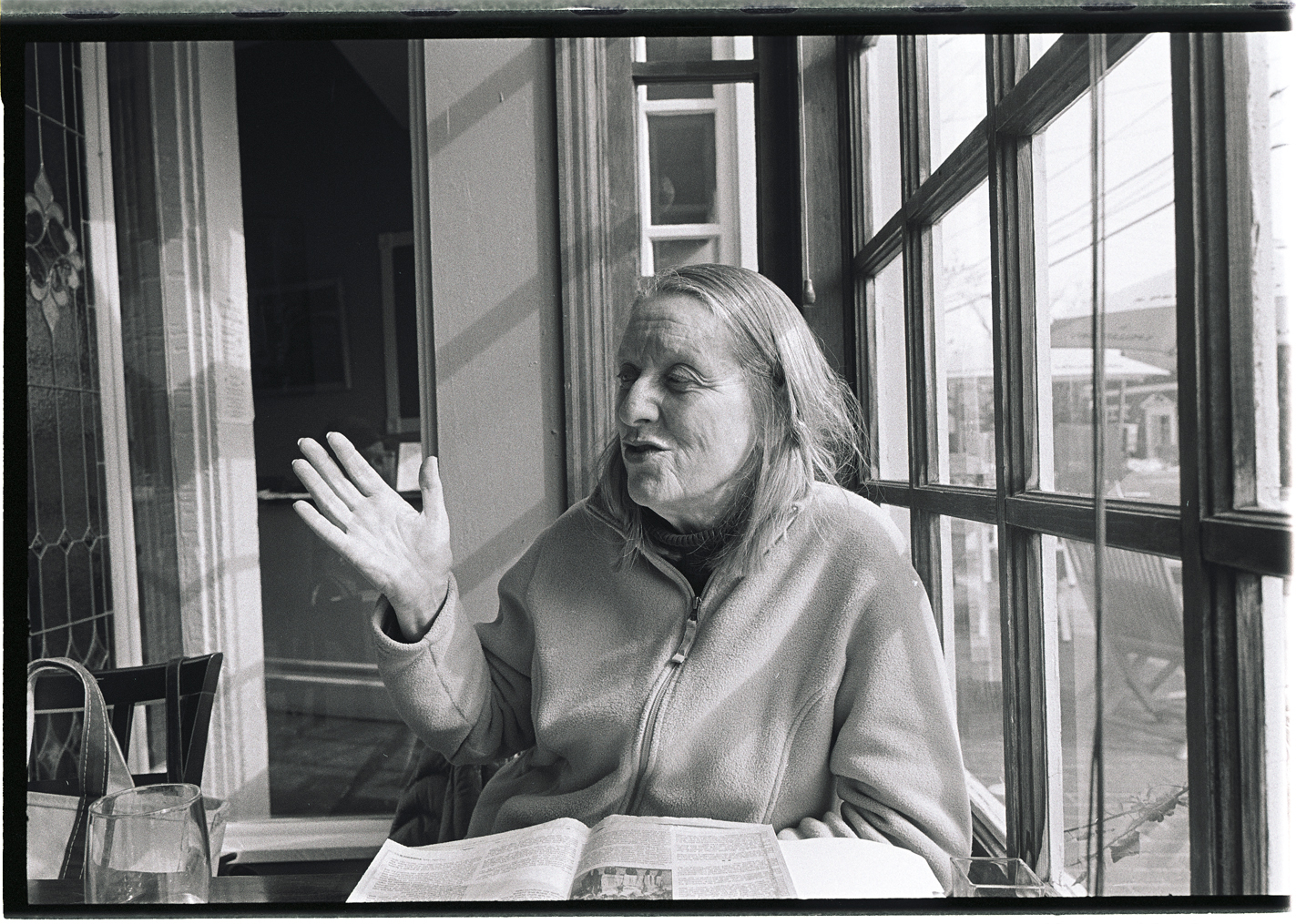
At first even  Mary Bishop was doubtful we would find her.  She hadn't talked to Mary Frances for awhile.  When she first interviewed her, Mary Frances had lived next to Jesse Meadows with other former Colony residents.   In her interview of Mary Frances for the Roanoke Times, Mary Bishop had reported that she had been sterilized as a child.  It was a disturbing story.  Sent to the colony at age 7, Mary Frances was just 13 when she was sterilized.  As Mary Bishop reported, the operation had almost killed her.
Mary Bishop

Since that interview,  Mary Frances  had moved away and Mary Bishop wasn't sure if she had the right address.  For a time we wandered around the parking lot of where we thought her building was.  It felt like we were going in circles.    Eventually we figured things out.   After making a call and then scrambling to get permission from her caretaker,  we were able to find Mary Frances and start our interview. 

At this point in the project, in addition to Rothstein's images, we carried the Corbin family chart as published in Audrey Horning's book, In the Shadow of Ragged Mountain.  Katrina Powell, being a scholar and Professor at Virginia Tech, thought it was  the important to bring it along.  I was skeptical.  I  felt we were repeating the routine of the eugenicists.  The last thing I wanted to do was to chart  Mary Frances's family history.  After looking at the eugenicists family trees,  I wanted to stay away from all of that.   In the end I would learn that was exactly what we wanted to do if we were to understand things.  Katrina was right, we needed to know where Mary Frances fit in.   
"The Colony"

At the beginning of the interview we thought it was another wild goose chase.  Mary Frances was not in good health.   Though she was alert mentally and she could clearly understand us, we often couldn't understand her.  We had to ask her the name of her parents more than once before we understood what she was telling us.  It didn't help matter much that she wasn't recognizing the people in the photographs at first either.  Though her story was important, it didn't seem to fit in with Rothstein.

Then Katrina asked Mary Frances one more time who her parents were.  We understood her this time. When we located them in the family chart we were stunned.  Mary Frances was directly related to the family Rothstein has spent so much time photographing.  The man at the head of the family was her grandfather, her father's father.  Rothstein had spent a lot of time photographing him.  In fact it seemed Rothstein had photographed everyone from Mary Frances's grandfather down to her aunts and uncles and even her cousins.  There was even a good chance he had photographed her, though she would have been a baby at the time and Rothstein did not identify many of the children in his photographs.

The full realization of what this meant would come a few days later.  Later in the week I received an email from Mary Bishop.  She told me that Mary Frances was stirred  by the pictures we had shown her and that she wanted copies.  She was starting to remember her days in Madison and she wanted to have copies of the pictures to look at again.  

When I started going through Rothstein's archive to make her copies,  it was  then that  I comprehended how closely related the majority of Rothstein's subjects were.  Rothstein's archive on this assignment was essentially Mary France's family album. Most of Rothstein's photographs were of her family.  This realization was all the more stunning since Mary Frances didn't have any family photographs in her home.  Her life had been so disrupted, she hardly knew who her family was.